Thirteen posts ago, we started with a simple premise: Generative AI is moving too fast for traditional software engineering to keep up.
When we began this series, the industry was drowning in hype. Everyone was building lightweight chat wrappers around cloud APIs and calling them "agents." But as we quickly discovered, what works in a local Python script or a hackathon completely falls apart when exposed to 10,000 enterprise users.
This series was never just about learning the Gemini API. It was about engineering discipline.
Over the course of "The Agent Architect Series," we took a shared journey. We bridged the massive gap between Full-Stack Web Development and Enterprise AI Architecture. Today, I want to look back at exactly how our mindset—and our code—evolved, and lay down the manifesto for the next era of AI engineering.
The Evolution: From Developer to Architect
If there is one core thesis to this entire 13-part series, it is this: Building an AI is easy. Defending, scaling, and verifying an AI is incredibly hard.
Look at how our approach shifted over the two "Seasons" of this journey:
The Junior AI Developer Mindset | The Enterprise AI Architect Mindset |
Passes the whole document in the prompt. | Uses Context Caching to slash latency and costs. |
Trusts the model's output blindly. | Uses LLM-as-a-Judge CI/CD pipelines for deterministic scoring. |
Writes a "friendly" system prompt. | Writes strict, structured RCCO prompts to enforce behavior. |
Sends raw user input to the cloud. | Builds Middleware Interceptors to scrub PII and block injections. |
Defaults to the biggest cloud model. | Routes to Gemma / Edge AI for air-gapped, offline deployments. |
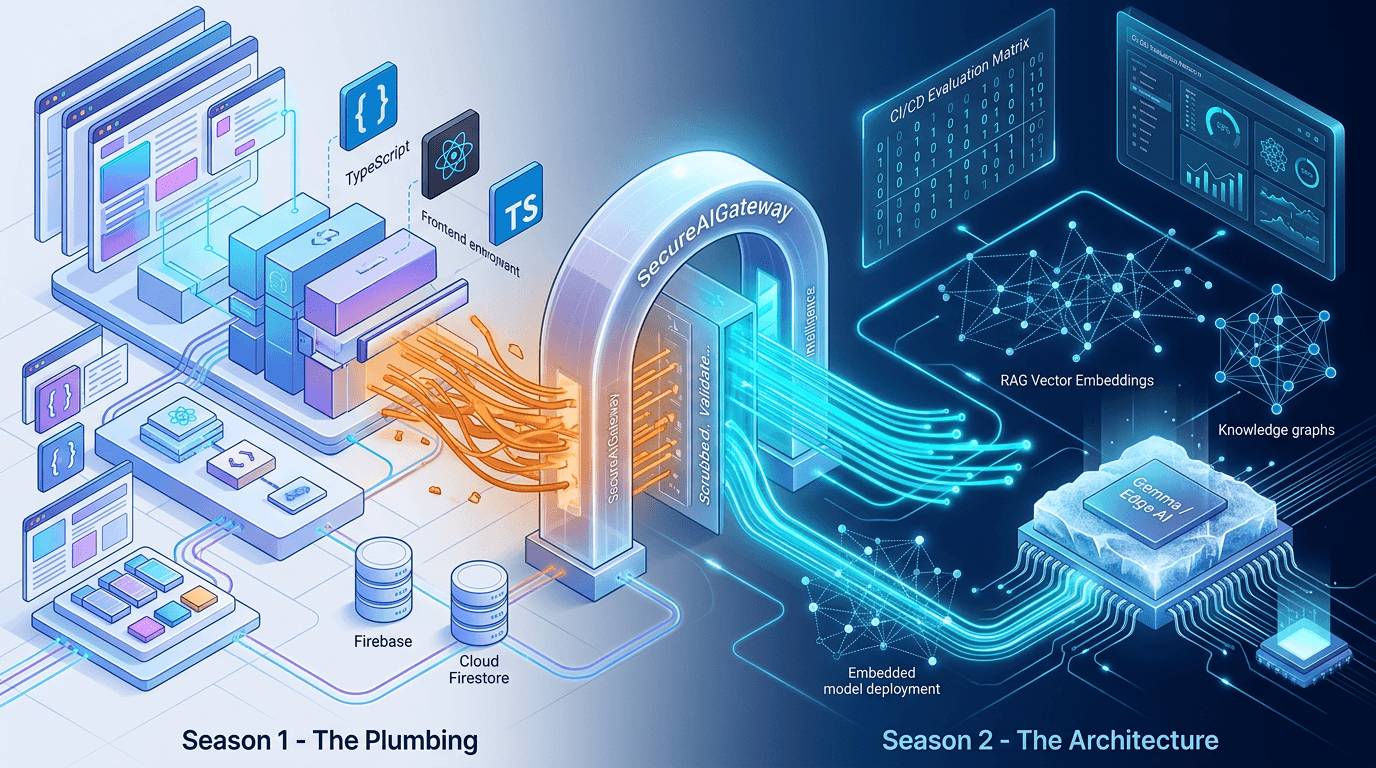
Season 1: The Full-Stack Plumbing
We spent the first half of this journey mastering the integration layer. We didn't start with Data Science; we started with React, TypeScript, and Firebase.
We learned how to use Firebase Genkit to create secure, callable cloud functions. We built the actual UI components necessary to stream tokens to a client. We learned that before you can make an AI "smart," you have to build the secure pipes that allow it to communicate with your frontend without exposing your API keys to the public internet.
Season 2: Enterprise Intelligence and Scale
Once the plumbing was stable, we took off our Web Developer hats and put on our Data Science and Architecture hats. We moved into pure Python and tackled the hard problems of scale.
Grounding with Truth (RAG): We stopped letting the AI guess and forced it to cite its sources using Vector Databases and Retrieval-Augmented Generation.
The Economics of AI: We realized that defaulting to Gemini Pro for every query is a great way to bankrupt your cloud budget. We learned to route traffic to Gemini Flash and implemented Context Caching to make reading 500-page PDFs blazing fast and incredibly cheap.
The Safety Layer: We acknowledged that users will try to break our systems. We built the SecureAIGateway to scrub Social Security Numbers and block jailbreak attempts before the data ever hit Google's servers.
Mathematical Verification: We stopped relying on "vibes" to test our prompts. We built a CI/CD pipeline where a superior model (Gemini 2.5 Pro) mathematically audited our worker models for Correctness and Groundedness.
Taking it Offline: Finally, we proved we don't even need the cloud. We downloaded Google's open-weights Gemma 2 model, snapped on a custom LoRA Adapter, and ran proprietary enterprise intelligence completely offline on local hardware.
The Manifesto for What's Next
The era of "wrapper apps" is over. The companies that will win the next decade are the ones that treat AI not as a magic API, but as a core architectural component that requires the same rigorous security, testing, and cost-optimization as a traditional SQL database.
To the developers who followed along, wrote the code, debugged the syntax errors, and shifted your mindset: You are no longer just software engineers. You are AI Architects. You now possess the exact blueprint required to build verifiable, secure, and scalable intelligence.
The tools will change. The models will get smarter, faster, and cheaper. But the architectural principles we built together—Defense in Depth, Context Routing, Deterministic Evaluation, and Local Inference—will remain the foundation of enterprise engineering for years to come.
Thank you for building alongside me. Now, let's go build the future.